MEMOIRS OF A HOUSE
Splendour, decline and rebirth: just as Erich Kästner once did in his vivid books, the Grand Hotel Kitzbühel tells its story here. Unfortunately, however, this is no tale for children. Too much has happened here. Much that was good, breathtakingly glamorous, but sadly also much that was bad. But now read on and immerse yourself in my memoirs.
In the beginning, there was an idea
As always, my story begins with an idea. Franz Reisch, the father of Kitzbühel as a tourist resort, had a vision of a prestigious hotel in the style of the establishments in Sulden and Karersee. And as is often the case when one is truly passionate about something, the right people come together. On 14 January 1902, six gentlemen from Kitzbühel founded the Hotelbau-Verein Kitzbühel.
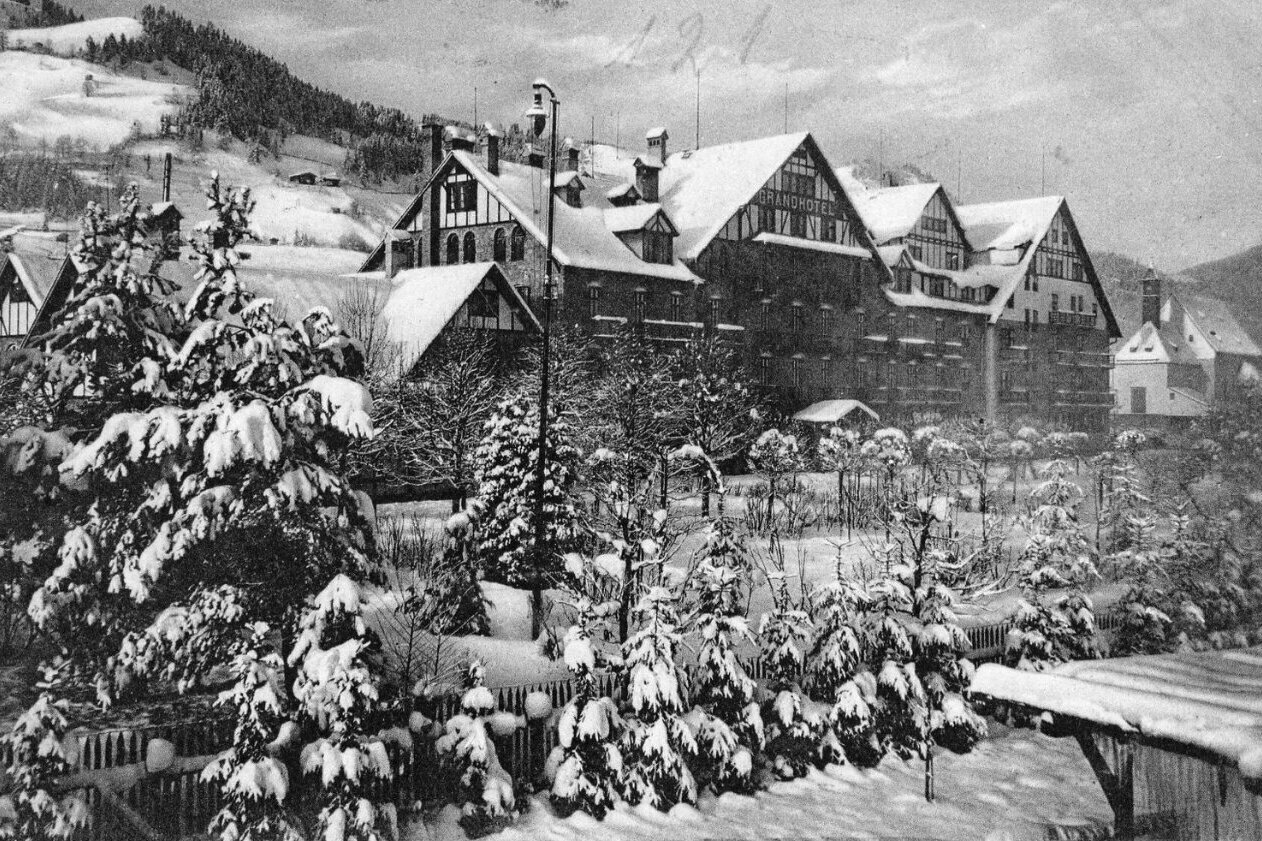
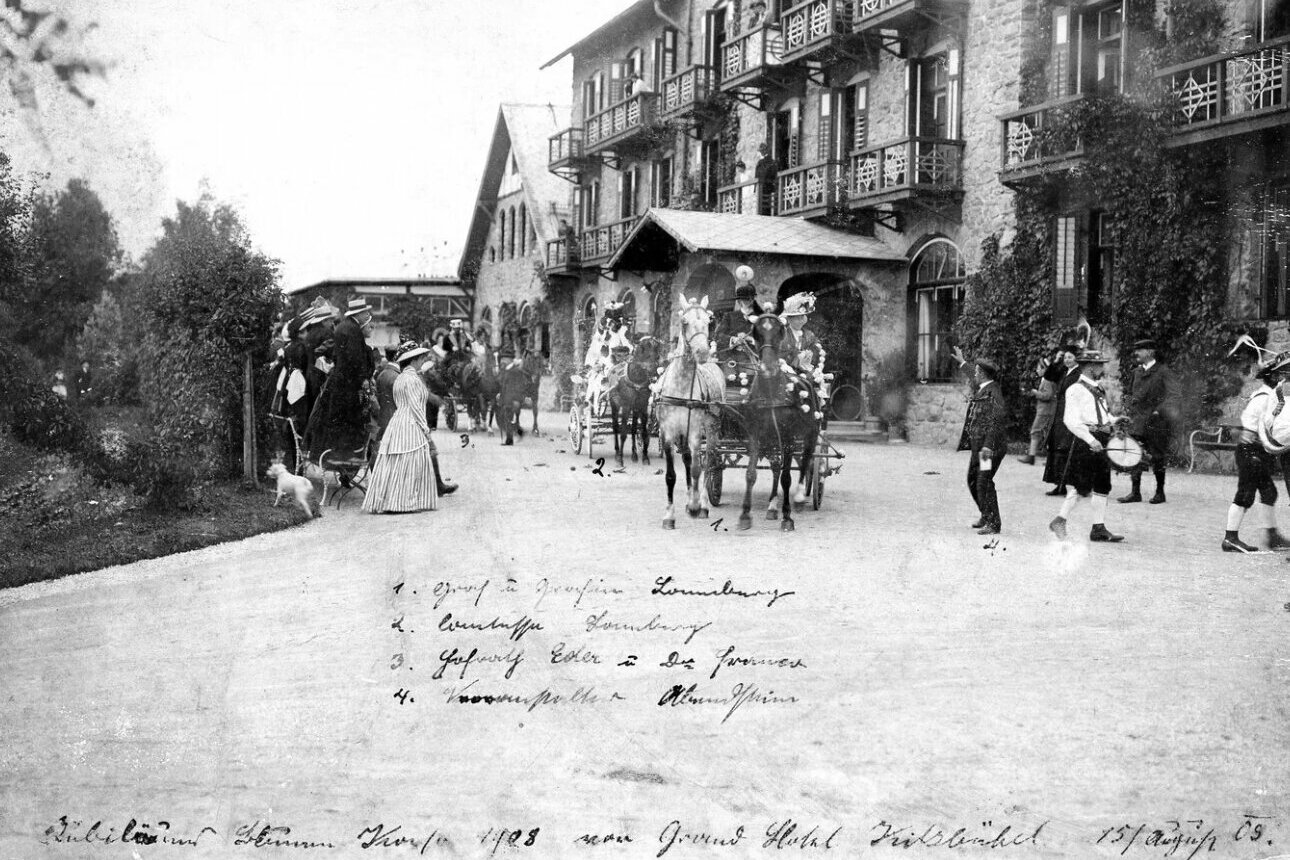
Full of enthusiasm, they commissioned the architect Otto Schmid, who was himself the builder and co-owner of the Grand Hotel in Sulden. And just imagine: the very first photograph of me was taken in September 1902 – at the topping-out ceremony, surrounded by the town’s dignitaries. It took less than a year before the opening. From 12 July 1903, I welcomed my first guests as the Hôtel Kitzbühel – on a 43,000 m² open plateau with gardens and tennis courts, 80 rooms, steam heating, bathrooms, electric lighting in all rooms, a lift, a grand hall, a large dining room, a beautiful restaurant area with a veranda and garden, as well as a ladies’ room, a music room, a reading room, a billiards room and a photographic darkroom. Everything went very well, and so Kitzbühel was able to welcome over 1,000 more guests than in its best years before.
A stately residence for the wealthy and the aristocracy
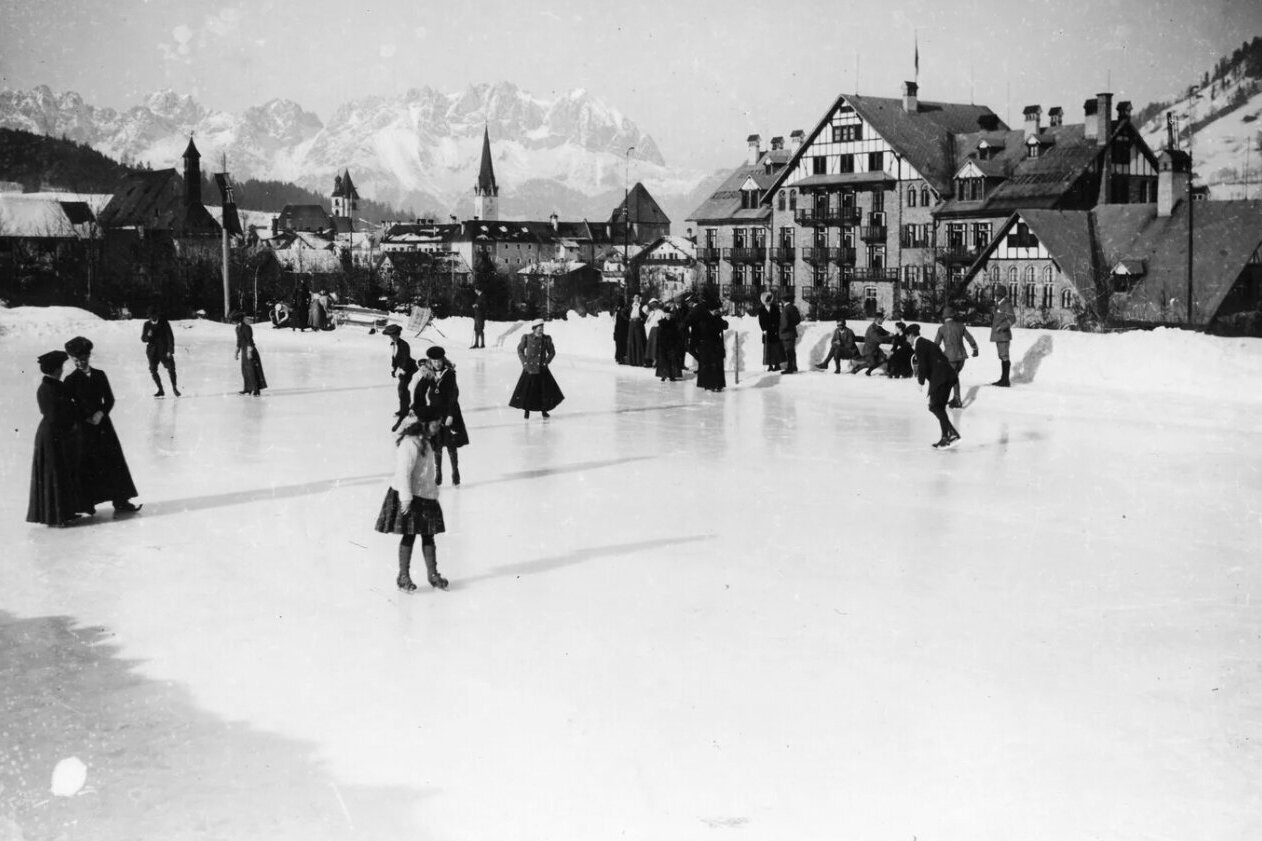
And so my story began to take shape. After a few years, I was renamed: ‘Grand Hotel’ would be more fitting, the shareholders felt. I was made winter-ready, and Dr Anton Kofler, a member of the Provincial Government, acquired 25 per cent of the shares and took over the management. This was a huge undertaking for the then 53-year-old politician, as he was, amongst other things, a member of the Imperial Council representing the interests of North Tyrol in the Imperial Council. Nevertheless, he succeeded in turning me into a prestigious residence for the international financial elite and high nobility in the years that followed. We hosted wealthy guests from Hungary, Germany, England, Russia and North America. On 13 February 1911, the Imperial Vienna Gazette reported: “Kitzbühel is currently likely to occupy first place among Austrian winter sports resorts, apart from the Semmering.”
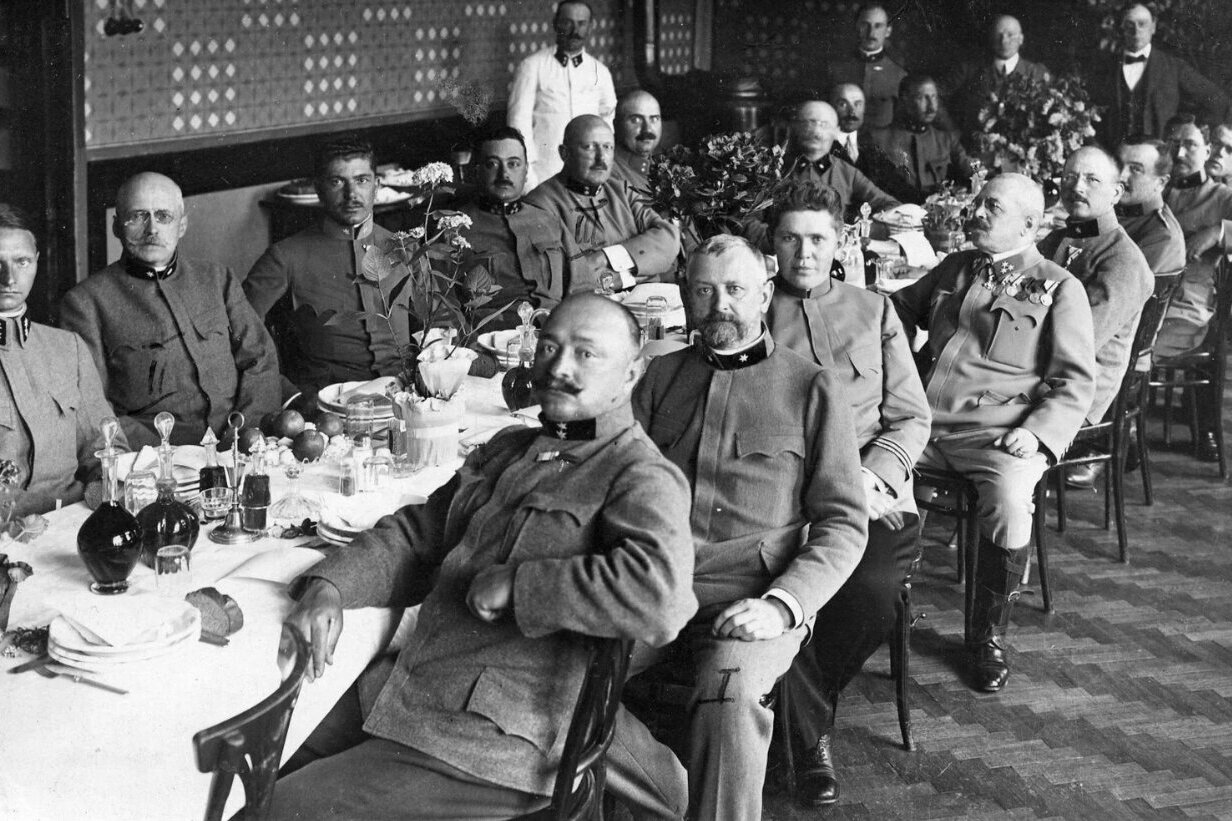
Golden years followed. But unfortunately, just as world history changed us all, the war years did not leave me unscathed either. After the outbreak of the First World War in the summer of 1914, the male staff had to go off to war. The first wounded soldiers were brought to me at the hotel, and I continued to serve as a military hospital. You can imagine how much renovation I needed after that time. But it was still a case of complaining on a high level. For many senior officers of the British occupying forces, along with their families, and foreign regular guests arrived after the war. Foreign currency flowed into the coffers, enabling renovations and modernisations until the mid-1920s. The citizens of Kitzbühel had a comparatively much harder time of it. And so, dear readers, it will certainly come as no surprise to you that the social tension between illustrious guests, representatives of the financial elite, representatives of the war victors and the local population was enormous. The miners even threatened to storm the Grand Hotel. Fortunately, it remained at the threat stage.
A time of revelry without limits
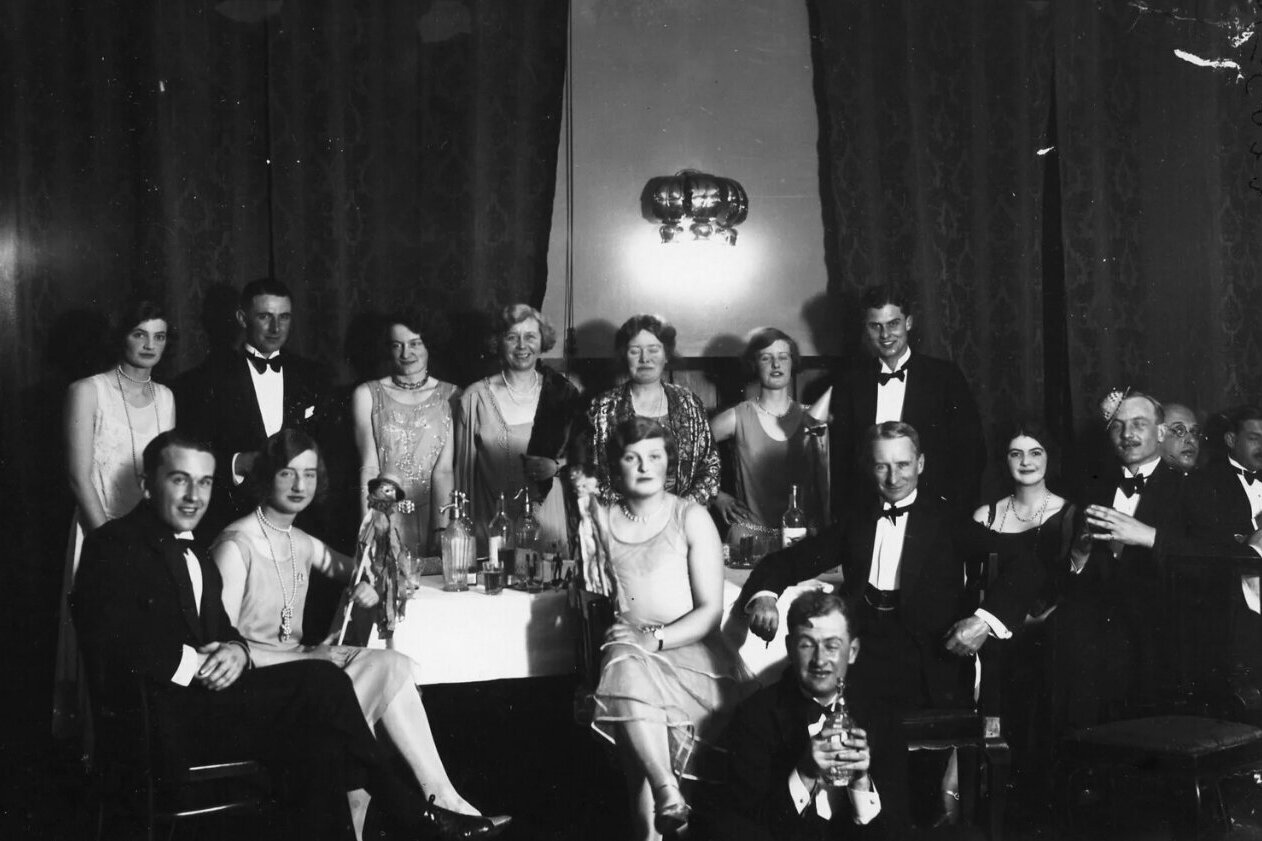
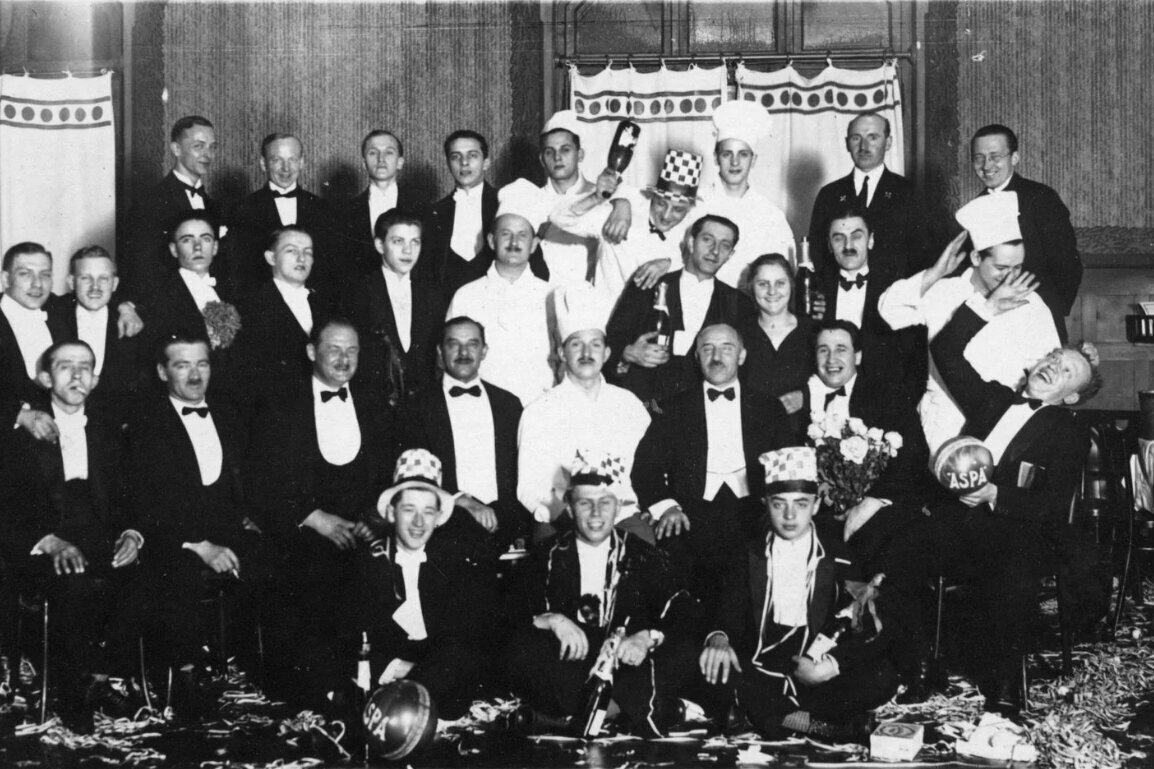
Over time, everything seemed to be picking up again. The first guests began arriving in their own cars. Year after year, I was renovated and expanded. Russian émigrés, industrialists, business executives and financiers who had made their fortunes during the war now came to stay with me. By 1925, I was almost fully booked. The same was true of the Grand Hotel ski school attached to me, which was run by the Monitzer brothers. I will never forget Rudi Monitzer and his legendary sayings. At that time, the grand balls and performances also took place – up to two or three balls a week. The social director, Teddy Haas, achieved great things with his team of decorators. For example, at the Apache Ball they transformed me into a zoo, or redesigned me for an African night: Hours in Paradise. At the balls, there were often six bands playing. Later in the evening, the night owls among the guests continued the celebrations in the Lumpenstüberl, a cosy bar in the cellar.
A home for the nobility and aristocracy
My personal heyday was undoubtedly reached in the mid-1930s: I became a showpiece – furnished with comfort and elegance, both artistically and in terms of interior design, with valuable paintings and sculptures. And so it was probably my personal crowning moment: the Prince of Wales’s holiday at the Grand Hotel in February 1935. Just one year later, he became King Edward VIII of England – albeit only for a short time. In the newspaper on 7 February 1935, I read: “Hardly ever before has so much luxury, so much elegance and so much money been gathered in a small Austrian town as is now the case in Kitzbühel.” Europe’s high aristocracy, millionaires from Paris, Brussels and Amsterdam, and stars from the world of film and theatre had travelled to Kitzbühel, and there was a great desire, particularly among the English and Americans, to stay in Kitzbühel in the shadow of the famous guest. Kitzbühel was fully booked right into March. A dedicated telephone line had been installed for the Prince, along with five further lines for the press.
Colourful turns to brown
But then war broke out once again: the Second World War. The colourful, glittering, international crowd was replaced by a wave of guests from the German Reich. I was accordingly decked out: with swastika emblems and banners above the gable. It was a paradoxical time. Despite the outbreak of war, New Year’s Eve was celebrated in full swing in 1940, and during the winter season there were only 200 fewer guests in Kitzbühel than the year before. So the hotel continued to operate. I became a refuge for representatives and staff of the Nazi-friendly governments of Albania, Bulgaria, Serbia and Slovakia. History was made once again in May 1945, when the interrogation of the Nazi Hermann Göring, the later convicted war criminal, took place in my room 128. Because of the overly friendly treatment he received, the American general in charge was immediately recalled to the USA. On 9 May, Göring was then arrested in one of my smaller rooms and taken to Luxembourg. In the summer of 1945, I became the headquarters of the French occupying forces.
The fading charm
Looking back, I made a fresh start of sorts after the Second World War. Some of my regulars returned, and I still had enough charm to attract interesting guests, such as the Persian imperial couple or stars and starlets from the film world. But in the 1960s and 1970s, my lustre began to fade. Necessary, major investments were not made, for Dr Ekkehard Kofler’s maxim had always been to keep the hotel debt-free and his co-partners happy, so that they would give him a free hand in all decisions. He had steered the hotel’s fortunes so admirably! All those successful decades can be credited to him. But his way of thinking clashed with the ideas of his sons, who wanted to modernise me. But to no avail. Dr Ekkehard Kofler could not let go of me. And so it came to pass as it must have been: when Dr Ekkehard Kofler died on 30 June 1982, he still owned more than half of the share capital. Thus, until then, at the proud age of 92, he determined the fortunes of my establishment. The fact that his sons had been managing directors in the company since the 1970s had had little effect – apart from the renaming to ‘Park Hotel’ in 1976, which came with a redefinition of the target audience. My glory days were numbered.
Finally, on 1 October 1983, I was sold to Asia Oil Mineral GesmbH. The sale was preceded by a decision by the local council in July 1983 that I might be demolished and a new 5-star hotel built here. What a disgrace! But fortunately, time, tenacity, insight and human frailty were the factors behind my success. The representative of the new owners who appeared turned out to be a shady financial juggler and was eventually arrested in Vienna in February 1992 for his dubious dealings. Josefine Sulzenbacher, a local from Kitzbühel, fought like a lioness for me and actually managed to persuade the Federal Monuments Board to change its mind: the preservation of the Parkhotel was in the public interest.
The low point and the renaissance
I became an eyesore in Kitzbühel. In the 1990s, I turned into a refuge for the homeless, drug addicts and hooligan youths. As if that weren’t bad enough, on 5 December 1991, Georg Perauer, the former garage attendant and caretaker for Dr Ekkehard Kofler, was murdered with two shots in the garage behind the Park Hotel. Many theories and accusations circulated. But the perpetrator has still not been found. And to top it all off, I also had to endure the fire in my roof truss in February 1994.
Fortunately, after rain comes sunshine. And for me, that sunshine has a name: Ernst Freiberger. He recognised my potential and had the patience, money and contacts to resolve all the confusion surrounding me, and bought me along with the land. On 2 January 1996, he made it official via a press release and promised: “This is how Kitzbühel will regain what it once possessed and has long missed – a premier destination for discerning tourists, businesspeople and international conferences: a grand hotel with tradition and a modern ambience.”
As we know today, he was unable to fully fulfil that promise. Too many obstacles were placed in the path of the dedicated entrepreneur Ernst Freiberger. Unfortunately, the planned 5-star hotel with 150 rooms, a conference centre for 1,000 participants and the 5-star sports rehabilitation clinic never came to fruition. But he was tenacious enough and, together with Prof. Dr Herbert Henzler, found a solution that could be realised: in 1998, the gutting of my building began. I was carefully restored. In particular, the former Great Hall with its precious wooden ceiling has since shone as brightly as it once did. In February 1999, the work was completed, and I was opened in all my splendour: not as a hotel, but as a place of intellect and education. Since then, up to 100 young managers from all over the world have been coming to me every week. They appreciate the historic surroundings, the tranquillity of the park and the central location in Kitzbühel. For over 25 years, I have embodied the McKinsey Alpine University, a management learning centre at the Grand Hotel Kitzbühel.