The Streif
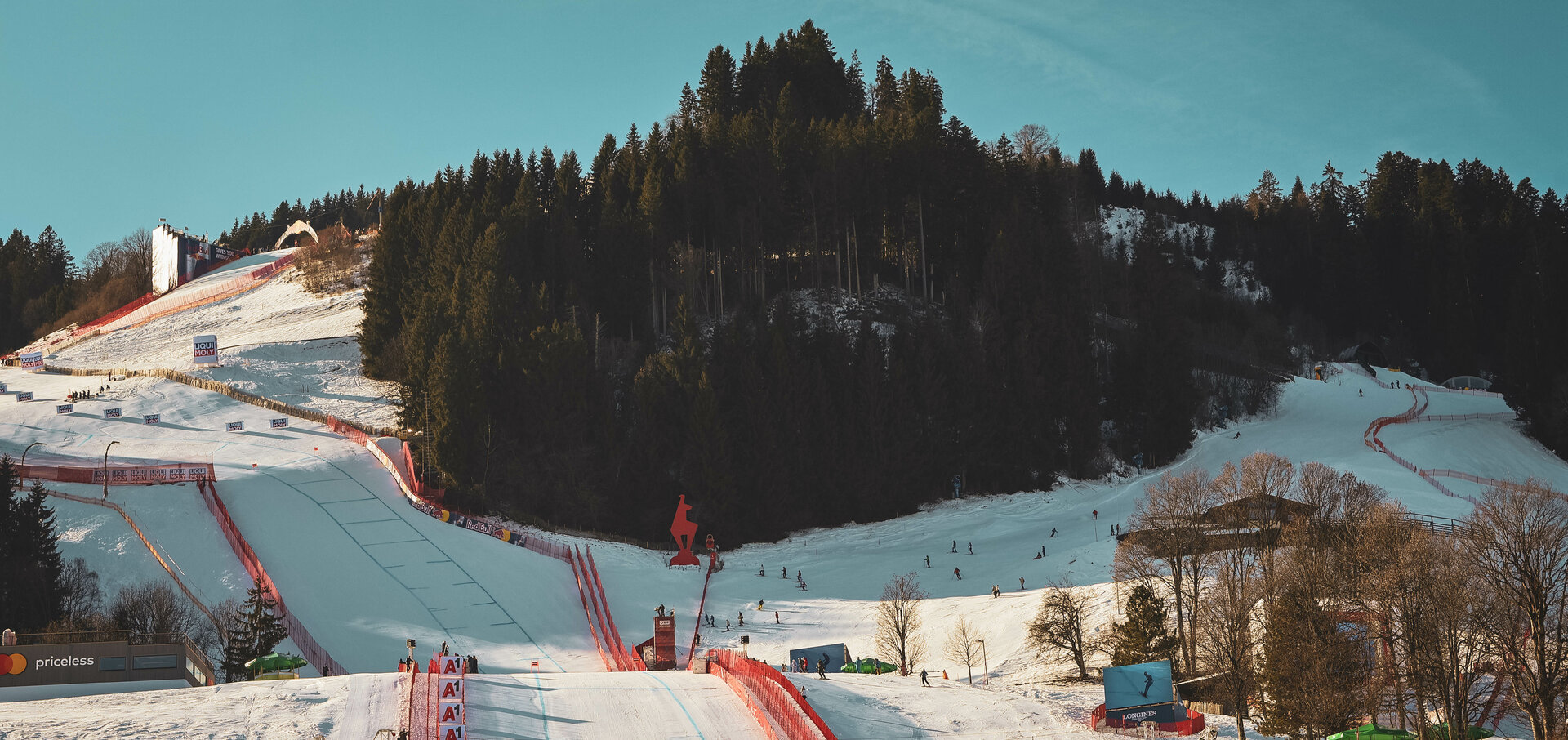
The Streif is one of the most demanding downhill runs in alpine skiing. Its legendary reputation is defined by its extreme steepness, high speeds and technically challenging sections.
From 18 to 24 January 2027, the legendary Hahnenkamm Races will be held here for the 87th time.


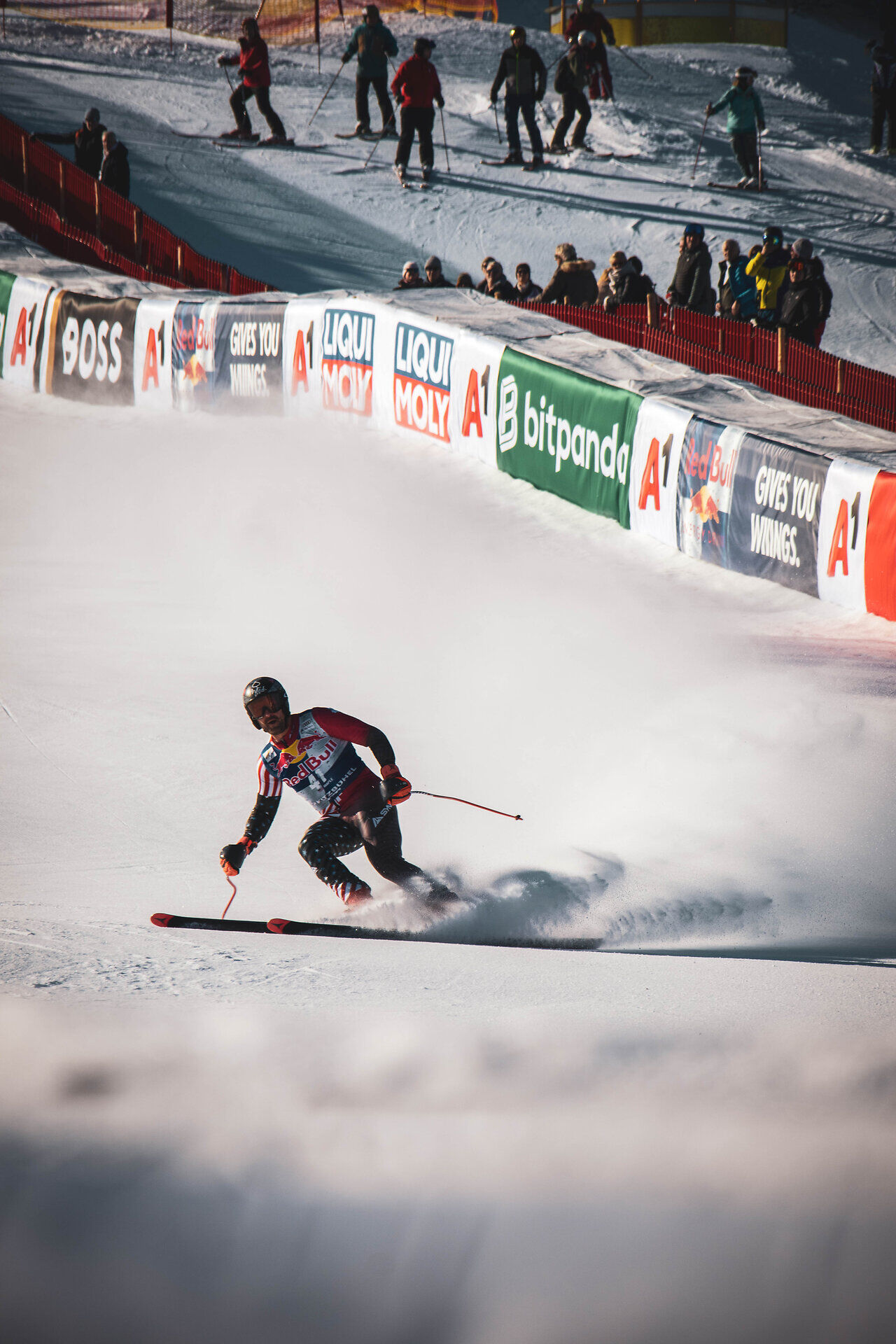
Ski World Cup in Kitzbühel
The Hahnenkamm Races are the most legendary ski races in the world. Since the first race in 1931, the downhill on the Streif and the slalom on the Ganslernhang have become classics in the Men’s Ski World Cup. For many athletes, a victory on one of these two historic courses is equivalent to an Olympic victory.
In 2027, the Hahnenkamm Races will take place for the 87th time. The race week runs from 18 to 24 January, with the downhill training session providing the first highlight. Incidentally, admission to the training session is free.
Tickets are available exclusively in advance; there is no on-site sales. Children get in free, and tickets for adults are available from EUR 35.00.

Tickets
Tickets for the Hahnenkamm Races are expected to be available from August on hahnenkamm.com. Buy early to avoid disappointment.
Programme
The programme will follow.
The programme will follow.
The programme will follow.
The programme will follow.
The programme will follow.
The Streif
The Streif is considered the most demanding and difficult downhill course in the world. Explore the course section by section and discover what makes the Streif so unique.
In one of the most adrenaline-fuelled starts on the World Cup course, the skiers leave the start gate at an altitude of 1,665 metres and head straight down the 51 per cent gradient start slope, followed by a series of fast right and left turns, before reaching the first jump at the Mausefalle in just 8.5 seconds.
Racers fly through the air for up to 80 metres, hurtling down a slope with an 85 per cent gradient at speeds of 110 to 120 km/h. This is a real test of the racers’ skill and nerves. As the slope levels out, the G-forces put the skiers’ leg strength to the test before they enter the Karussell.
The Karussell is a challenging 180-degree bend that leads into the Steilhang. At the foot of the Steilhang lies a hair-raising right-hand turn across the steep slope, where riders often struggle to make it through without touching the fence. Taking a clean and efficient line through the Karussell and the Steilhang is crucial for the racers, as any mistake can cost them a lot of speed and time. The Steilhang has been the scene of many serious crashes, but the most famous moment came in 2008, when Bode Miller narrowly avoided a crash by skiing on the fence.
The ‘Brückenschuss’ and the ‘Gschöss’ are the first flatter sections of the course after the steep slope, where the racers can take a short breather. It is, however, a crucial section, as the speed the riders can carry over from the Steilhang onto the flat section can make a huge difference to their overall time and easily determine the difference between victory and finishing several places lower in the overall standings.
At the end of the Brückenschuss and the Gschöss, there is a drop down into the Alte Schneise, a steep, gently curving slope with a hollow at the bottom, which leads the racers to the Seidlalmsprung.
A blind jump right in the middle of the course, next to the Seidlalm restaurant, where the Ski World Cup was founded in 1966. The Seidlalm jump takes the skiers through right, left and right turns and onto the Lärchenschuss. In good weather, the racers use the position of the Kitzbüheler Horn on the other side of the valley to align their jump with the best line.
This is the last chance for the riders to gather their strength before the demanding final stretch. After a slightly gentler descent, the riders reach a flatter section with a few bends at the end to prevent them from approaching the Hausbergkante at too high a speed.
This jump and the traverse overlooking the finish area were the bane of many racers’ existence. When the skiers’ legs grow tired, they face a blind jump onto a steep slope, followed by a sharp left-hand turn to cross the icy slope. Finding a good line here is crucial for the racers, because once the angle of descent is set, they bounce over the ice and are constantly thrown into the air without much chance to change direction. Generally speaking, the higher the skier stays on the slope, the faster they can reach the finish. Many races have been decided by how the skiers tackle the traverse, with some competitors not even making it round the bend and ending up in the safety nets at the bottom.
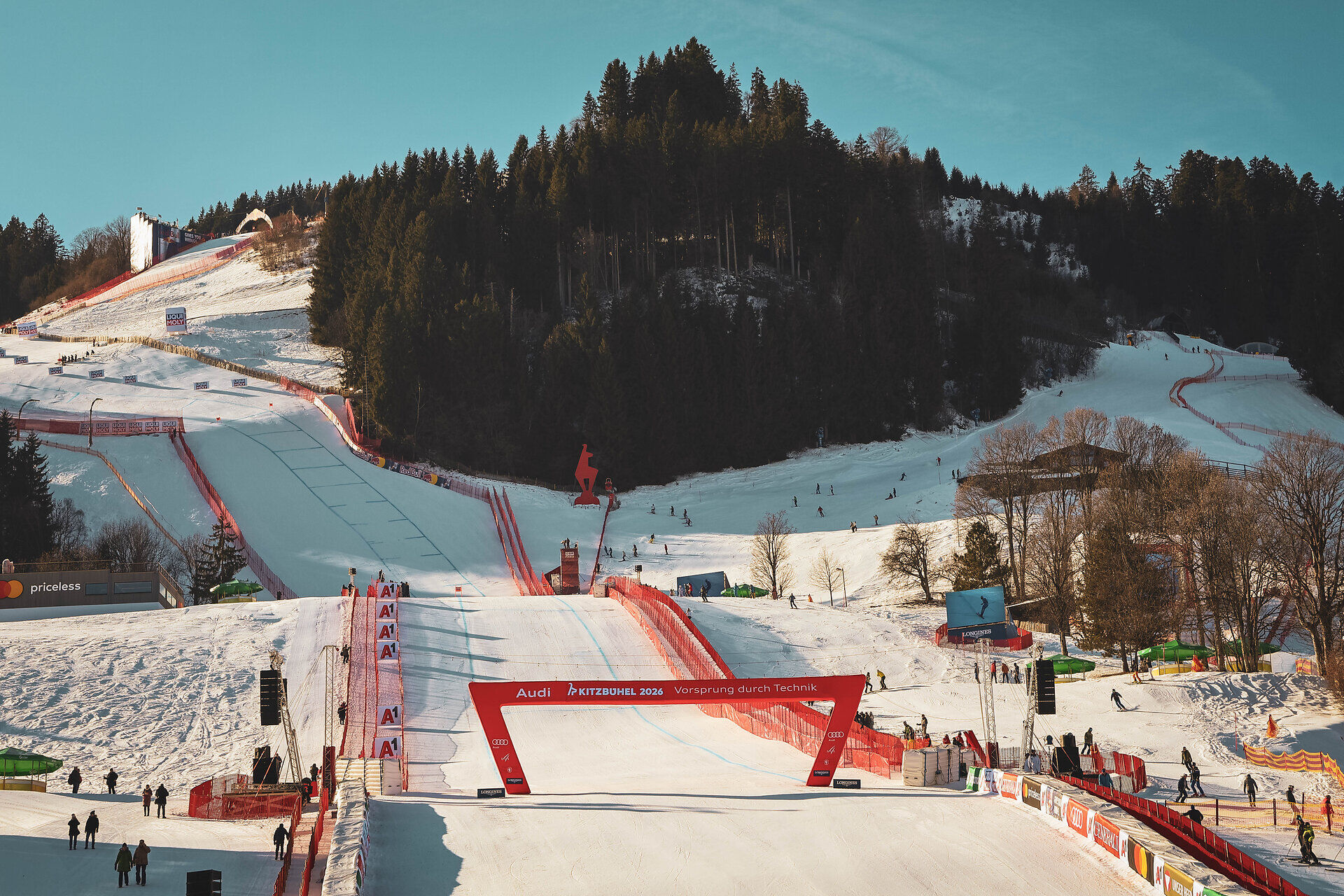
In full view of the spectators, the ski racers hurtle down the final steep straight section – the fastest section of the course – at speeds of up to 150 km/h, heading for the finish jump.
Just before the finish line, there is one final jump: the finish line jump. How far and how high the runners jump varies from year to year, and although it is supposed to be a mere formality, this final jump has pushed many athletes to their limits over the years.
The heroes who make it across the finish line are cheered on by 80,000 or more spectators, who eagerly await their finishing times. The atmosphere is unique, and the best racers complete the course in under two minutes.
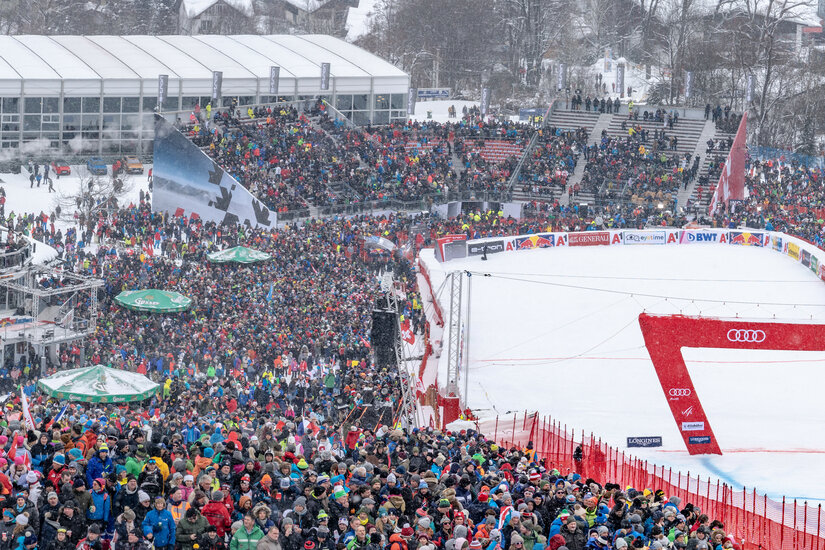
Spectator area and finish line
The main spectator area for the Hahnenkamm Races is located in the finish area and boasts a unique atmosphere. Fans from many different countries gather here to experience the thrill of skiing right in the heart of Kitzbühel. Several areas offer excellent views of the race course and the action in the finish area.
Stalls selling drinks and snacks are available throughout the finish area. Large screens show the race from the start right up to the moment the athletes come into view in the finish area.
The finish area is just a few minutes’ walk from Hahnenkamm railway station and is therefore easily accessible by train. Toilet facilities are available in almost all areas.
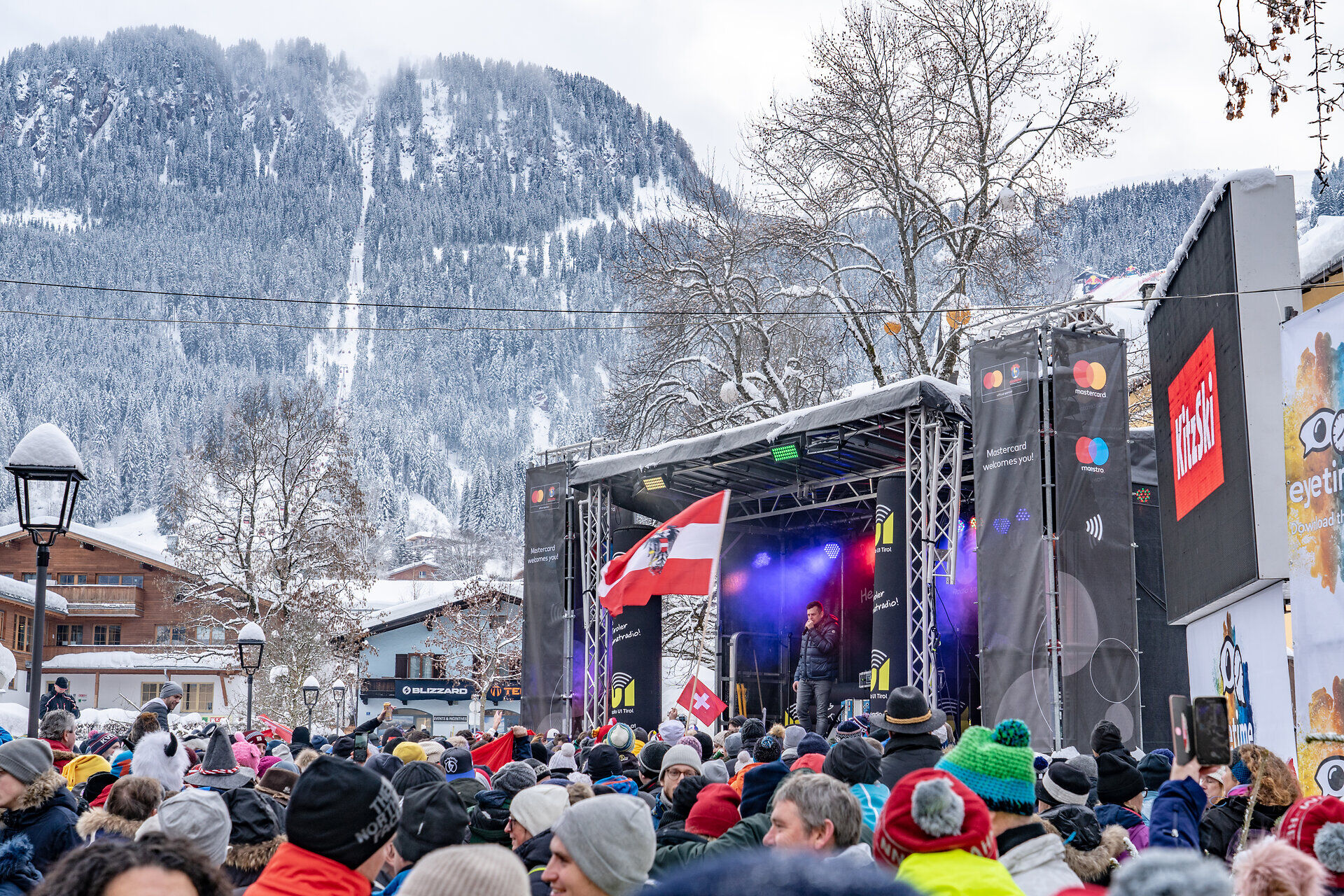
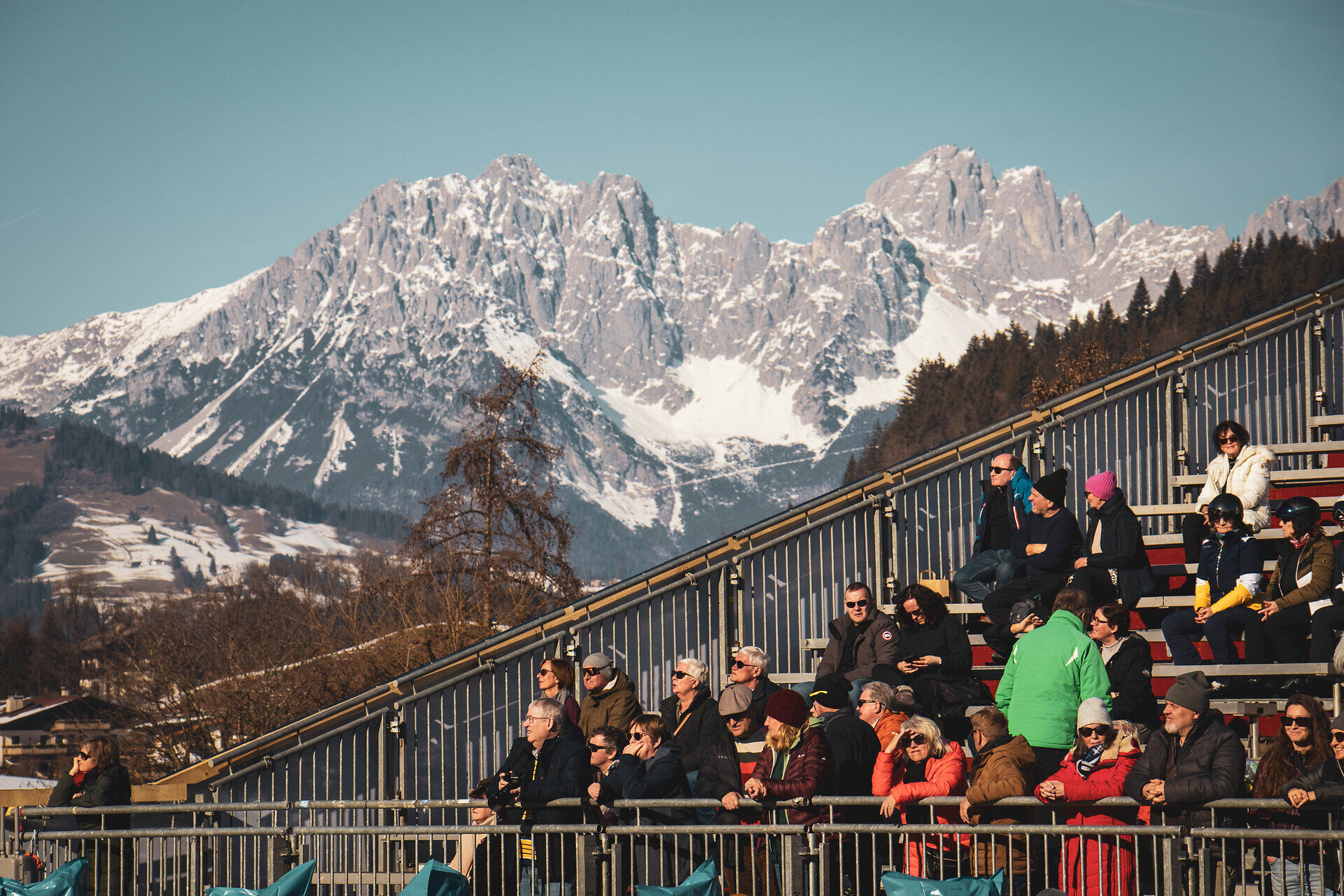
Fan zones and parties
Throughout Hahnenkamm Week, there’s a lively atmosphere in Kitzbühel. In the town centre, along the race course, in restaurants and bars, and at mountain huts, there’s plenty on offer to encourage you to linger.
A central meeting point is the fan zone in the town centre and the area near the race course. In the town centre and in the town park, you’ll find numerous stalls serving food and drink. Live music in the town park and a radio studio in the town centre ensure a wonderful atmosphere well into the evening.
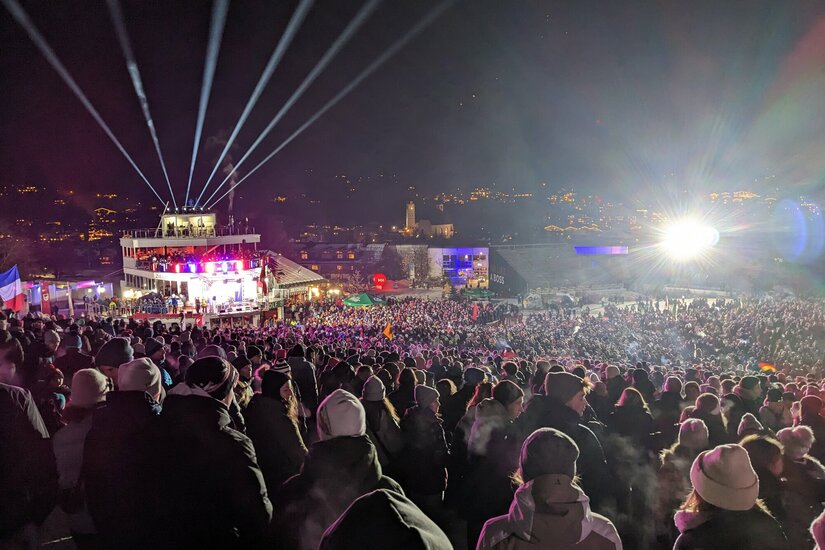
Awards ceremony and race number draw
The awards ceremony and the draw for race numbers are among the special highlights of the Hahnenkamm weekend. Here you can see the athletes up close and away from the race course. In the finish area, the huge crowd of thousands of fans creates a unique atmosphere.
Friday evening
On Friday evening from 6.00 pm, the start numbers for the downhill will be allocated. This will be followed by the Super-G awards ceremony.
Saturday evening
On Saturday evening from 6.00 pm, the start numbers for the slalom will be issued, after which the winners of the downhill will be honoured.
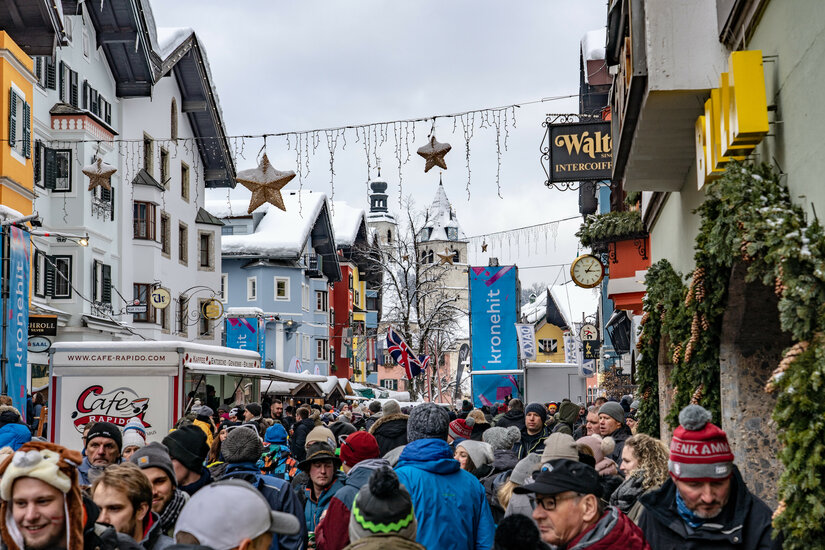
Getting to the Hahnenkamm Races & Road Closures
For visitors travelling from further afield on race day, there are several options for getting there. The route takes you via the surrounding villages around Kitzbühel, where parking facilities have been provided. Free parking is available in Kirchberg and Oberndorf. It is particularly important to arrive very early on Saturday – we recommend being there by 9:00 am at the latest.
From there, the free HKR-Express trains take guests comfortably to the race courses. The HKR-Express runs every 7.5 minutes between Kirchberg and St. Johann, stopping at Kitzbühel Schwarzsee, Kitzbühel Hahnenkamm, Kitzbühel Bahnhof and Oberndorf, amongst others.
During the races, there will be extensive road closures in Kitzbühel. Connections between the town centre and the race area will be completely closed; other roads in the immediate vicinity will be accessible only to residents and event staff. There are no parking facilities available directly in the event area.
FAQ
The Hahnenkamm Races are among the most traditional and best-known events in the Alpine Skiing World Cup. Every year, the world’s best ski racers compete in Kitzbühel in the Super-G, Downhill and Slalom disciplines.
The 87th Hahnenkamm Races will take place from 22 to 24 January 2027.
The programme includes the Super-G, the downhill and the slalom. The Hahnenkamm Week is rounded off by official training runs and an extensive supporting programme.
Tickets for the Hahnenkamm Races in Kitzbühel are available exclusively in advance – there will be no ticket sales on the day of the race.
Tickets for the general spectator area (standing room) can be purchased directly from the official ticket shop at hahnenkamm.com. Grandstand, zone and group tickets can be requested directly via the ticket form. Admission is free on training days.
Access to the Hahnenkamm Races venue is only permitted with a valid ticket. This applies to the finish area, the start area and all spectator zones along the race course.
The extensive finish area can be reached both from the Hahnenkammbahn and via the town centre/Legendenpark.
It is also possible to watch the race on skis or a snowboard along the Streif. Areas such as Mausefalleboden, Seidlalm and Oberhausberg are particularly well suited for this. Please always observe the safety instructions and barriers on site.
The finish area is considered the best spot for spectators at the Hahnenkamm Races. Here you can watch the final seconds of a skier’s run, from the edge of the Hausberg, live, and enjoy a wide range of entertainment and information. Video screens and scoreboards show the action along the entire course.
A dedicated “Family Zone” is available for families – a cordoned-off area with seating and refreshments. The “Family Zone” is located between the finish house and Rasmushof, near the downhill grandstand.
Other popular spectator areas include the start area and the Mausefalle. A single ticket for pedestrians is required for the ascent via the Hahnenkammbahn, and a valid ticket for the Hahnenkamm Race is also required.
It is also possible to watch the race along the Streif on skis or a snowboard.
Please note that winter-proof footwear with good tread is required in all areas along the course and in the finish area. The terrain is natural and wintry – instructions and barriers must be strictly observed.
Yes, there are food stalls selling snacks and hot and cold drinks within the Hahnenkamm Races venue. In addition, the Red Bull restaurant serves food and drinks.
Please note that bringing your own food and drink onto the event site is not permitted.
There is a dedicated family stand for families in the area between the Red Bull restaurant and the Rasmushof.
We accept cash, debit cards and credit cards.
Yes, toilet facilities are available throughout the Hahnenkamm Races venue. In total, around 300 heated toilets with fresh water and drainage connections have been installed in all central areas, including the finish area, the grandstands and the Ganslernbahn. Accessible toilet facilities are also available, and the toilet blocks are continuously maintained.
If you would like to attend the races in a wheelchair, please send an email to andreas.salvenmoser@hahnenkamm.com.
If you have any medical or health-related concerns, please contact the emergency operations centre. This is located at the East Entrance, below the downhill grandstand and next to the ‘Lost & Found’ desk.
No, dogs are not permitted on the event site.
The Hahnenkamm Races take place in the centre of Kitzbühel and are easily accessible.
Travelling by car
Direct access by car to the race area is not possible as the access roads are closed. Free parking is available in Kirchberg, Oberndorf and in the south of Kitzbühel.
Travelling by train
From Kirchberg and St. Johann in Tirol, the HKR Express takes visitors directly to the race courses free of charge and at regular intervals. The train runs between Kirchberg and St. Johann in Tirol, stopping at Oberndorf, Kitzbühel Bahnhof, Kitzbühel Hahnenkamm and Kitzbühel Schwarzsee. Kitzbühel Hahnenkamm station is located right next to the event site. From the southern part of Kitzbühel, you can also reach the race area in around 20 minutes on foot.
During the Hahnenkamm Races, there will be temporary road closures and traffic restrictions in the town of Kitzbühel and in the area surrounding the race venue.
The exact closure times and affected roads will be announced in good time before the race week. Visitors are asked to follow the on-site signage and to use public transport where possible.